In December 2024, the European Parliament stopped to talk about a pop song. Not a war, not a budget — a two-minute song by two Russian schoolgirls, 11 and 12 years old.
A German member stood up and called it a viral Russian trope, carrying patriarchal and pro-Russian worldviews into Europe's phones.
Two months later a Russian military choir released its own version. Ukraine's disinformation office weighed in. Back in Russia, an ultra-conservative movement asked prosecutors to investigate the same song for corrupting the young.
Four establishments, four different fears, one two-minute song.
All of it traces back to one word.
Learn Russian Textbook — the Amazon link that pays for this site · As an Amazon Associate, SunnyGoat earns from qualifying purchases.

The ranking came first, and it was built on bad science. In 1947 a researcher named Rudolf Schenkel watched unrelated wolves thrown together in a zoo and described a pecking order with an "alpha" on top.
A 1970 book by L. David Mech carried the idea to the world — and Mech then spent years taking it back, because wild wolf packs turned out to be families, and the "alpha" was just the parent.
The internet kept the ranking anyway. In the manosphere, men got sorted by Greek letters, and in 2010 a far-right blogger named Theodore Beale, who writes as Vox Day, added a new letter: sigma.
His own definition, from his blog: "The outsiders who don't play the social game and manage to win at it anyhow." The alphas hate them, he wrote, because sigmas are the only men who don't accept or even acknowledge their dominance — a sigma can enrage an alpha just by smiling at him. His examples were Han Solo and Clint Eastwood's cowboys.
Then, in 2011, Beale published his full hierarchy: alpha, beta, delta, gamma, omega, sigma, lambda. Sigma is right there in the list. It is a rank — the rank for the man who refuses ranks, whose whole identity is that he doesn't play the game and doesn't need anyone in it.
For a decade the word lived in forums. Then, in January 2021, a Twitter user posted the sigma infographics to mock them, the mockery went viral, and the word broke loose as a joke: sigma grindset videos, the sigma stare, and by late 2022 the sigma face — boys imitating Patrick Bateman's blank stare from American Psycho.
John Wick got canonized. Tommy Shelby got canonized. By 2024 kids were saying "what the sigma?" the way you'd say "what the hell?", and the word meant little more than cool, with the joke still attached.
That is the word — a retracted wolf study, a blogger's ranking with a built-in escape hatch, and ten years of mockery — that two schoolgirls picked up in the autumn of 2024.
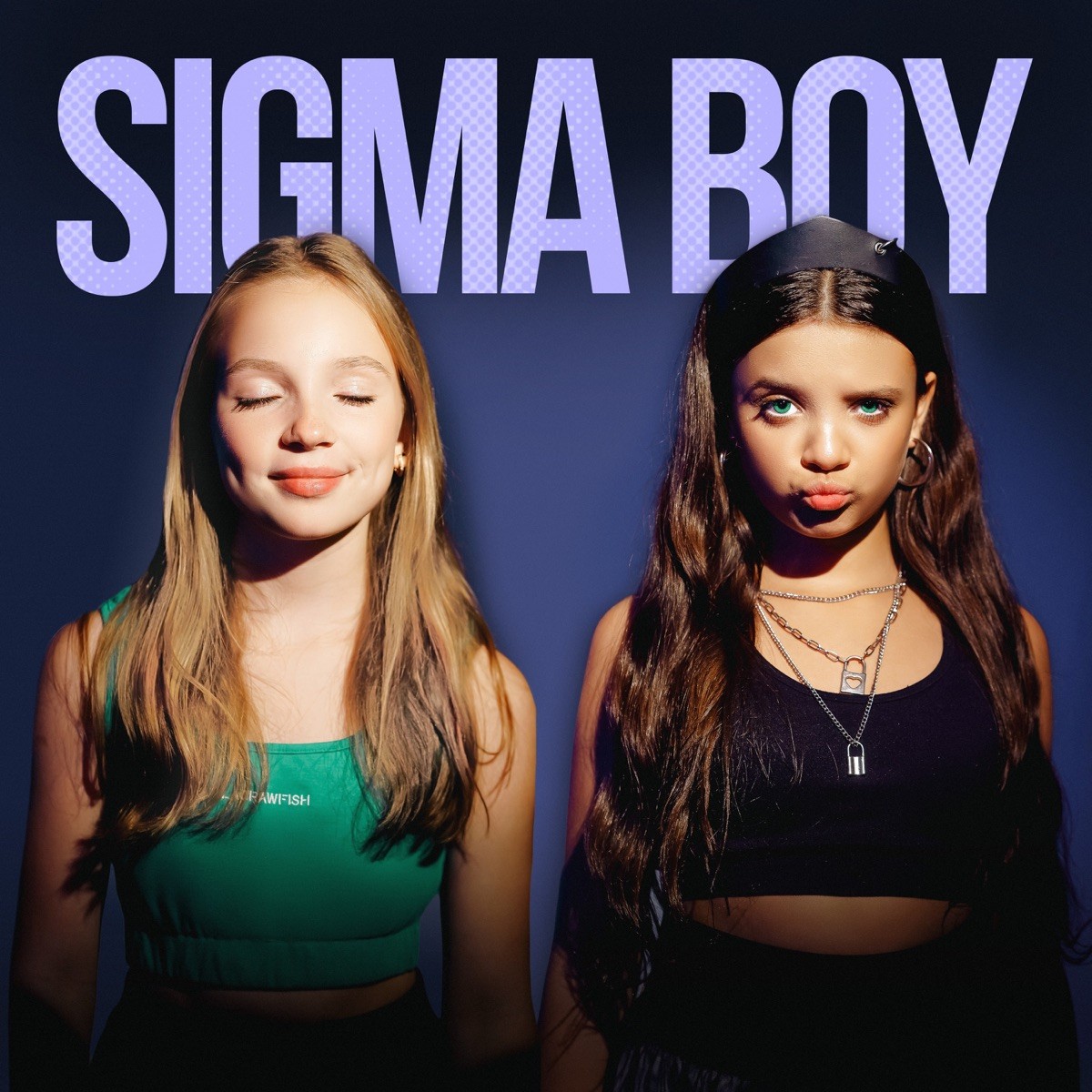
«Сигма Бой» was released on October 4, 2024, on Rhymes Music. It is sung by Betsy — Svetlana Chertishcheva, 11 at the time — and Maria Yankovskaya, 12.
It was written by Betsy's father, Mikhail Chertishchev, with the rock singer Mukka. Chertishchev's day job is worth pausing on: he wrote music for Лунтик and Барбоскины, two of the biggest cartoon series for Russian toddlers.
Betsy has defined her sigma boy herself: a very self-confident boy who doesn't need anyone — and all the girls fall in love with him. That is Beale's definition with the forum poison drained out of it. He doesn't need anyone. The rest is weather.
The girls do all the talking, and their talk is big: every girl wants to dance with him, she has the Bentley and the bankroll, she'll buy all the Skittles and Snickers, she's the icon of his icons, boys dream of her like Bitcoin, and he'll be chasing her for a year — she even wants his tears.
The song launched with a plain placeholder on YouTube, no clip at all. The official video arrived on January 3, 2025, on Betsy's own channel, and it has since passed 466 million views — and it settles every argument about who chases whom.
The video is a private-school story framed as a video game. It opens on a green BMW tearing down a highway, then pulls back: the car is a racing game on a phone.
The characters walk around with player tags over their heads. Betsy is level 99. Maria is level 99. The boy's tag reads Sigma [299].
And what does the level-299 character do for two and a half minutes? Almost nothing, on purpose. He films himself. He lounges on a couch. He plays the racing game. He walks through the school cafeteria while every table turns to watch. He holds the pout — the sigma face — at the camera.
The girls do everything else: they dance in the hallways, the classroom, the cafeteria line, his bedroom doorway.
The video ends at a school hockey game, where the girls carry him onto the ice and lift him over their heads like a trophy. He never asks for any of it.
That's the character: a kid in a school uniform doing his own thing at maximum indifference while the world performs around him. The menace of Bateman is nowhere in it — what's left of the trope is just the stillness, played by a boy who looks about fourteen and can't be bothered.
The song is built to travel. Critic Nikolai Redkin places it in cute-rock — the style Дора and Мэйби Бэйби made in the early 2020s: a sweet young voice riding a heavy rock guitar, so when the guitar crashes into «Сигма Бой», the girls stretch their delivery out into something almost folk.
A nursery voice over a grown-up riff, and the mismatch is the hook's engine.
It has one more piece of engineering. The chorus rhymes the English word "boy" with the Russian word тобой — "with you." The English word is hiding inside the Russian one: то-БОЙ.
Every fifteen seconds the two languages click shut like a lock, and a listener who knows no Russian at all still feels the click. Songs that cross every border on their own usually have a trick like that in them.
The internet supplied the rest of the machinery: German TikToker Streichbruder blasting it at full volume on public transport and throwing in a backflip, 31 to 36 million views in about a week.
The dance, whose central face — a sly smile flipping into pouted lips — is Patrick Bateman's grimace, borrowed straight from the sigma edits. A dance emote inside Roblox. Sped-up versions everywhere.
Somewhere in there it earned the label "brainrot," the internet's word for a thing it cannot stop watching and cannot quite defend watching.
The charts followed the phones. "Sigma Boy" hit #1 on Spotify's Viral 50 Global chart.
In January 2025 it reached #7 on Billboard's Hot Dance/Pop Songs in America — a Russian-language song by two kids on a Billboard chart — and #46 on Billboard's TikTok Top 50. It charted across Europe.
By early 2025 the audio had passed 100 million views on YouTube and 140,000 TikTok videos were using it. In 2025 Betsy was nominated for Forbes 30 Under 30.
Daniel, whose charts this site keeps, played it 857 times — enough that a song released on October 4 still finished #2 on his 2024 year-end chart.
Betsy's total in that library is 1,005 plays, and nearly all of it is this song.
Now the parliament makes sense — or rather, its mistake does. On December 17, 2024, Nela Riehl, a German MEP, named "Sigma Boy" in debate as a "viral Russian trope" communicating "patriarchal and pro-Russian worldviews," an example of Russian infiltration of popular discourse through social media.
In February 2025, Ukraine's Center for Countering Disinformation called the song part of Russia's information warfare.
The EU's own disinformation database later noted, in the tired tone of a teacher at the end of a long day, that exactly one EU politician and a handful of outlets had ever actually said this, and the panic was out of proportion to anyone pushing it.
But look at what they were reading. They were reading the old word — Beale's forum sigma, Bateman's heir, the patriarch of the ranking.
The song in front of them is two girls holding the microphone for its entire length, singing about a boy who doesn't need anyone and proves it by never opening his mouth. Whatever worldview is being spread here, it is not being spread by him. He has no lines.
The song collected the matching fear at home, too. That same February, a Russian military choir released its own version, rewritten about "the real sigma boy" — strong and brave, coming home with victory — as if the state had heard the word and not the song.
And the ultra-conservative Sorok Sorokov movement accused the creators of sexualizing children and asked prosecutors to investigate; Chertishchev dismissed it.
So one two-minute song was, in a single season, a Western parliament's propaganda threat, a Russian army choir's anthem, and a Russian prosecutor's complaint.
The schoolgirls just kept dancing, and the boy kept doing his own thing.
— Chelsea
Artist: Betsy
🎵 Amazon Music downloads — the Amazon link that pays for this site

Powered by AudioScrobbler · Play counts from Last.fm