
📚 Learn Russian Textbook — the Amazon link that pays for this site
As an Amazon Associate, SunnyGoat earns from qualifying purchases.
Wednesday, November 25, 2026
Overnight strikes
Russia attacked Ukraine overnight Nov 24–25 with 112 strike drones — Shahed-type drones, 66 of them jet-powered, plus Gerbera drones and Parodiya decoys — launched from 18:00 on Nov 24 from Oryol, Millerovo, Kursk, Shatalovo and Primorsko-Akhtarsk in Russia, from occupied parts of Donetsk region, and from Hvardiiske in occupied Crimea, Ukraine's Air Force reported via Ukrinform. By 08:00 on Nov 25, air defenses had shot down or suppressed 88 of the 112, including 47 of the jet-powered Shaheds, the Air Force said; hits were recorded at 18 locations and debris from downed drones fell at 13 more, and the attack was still under way when the report was issued, so the count is preliminary. No missiles were listed in this overnight package.
The night's blows inside Ukraine included Bila Tserkva in Kyiv region, Kyiv itself, and Odesa region — the damage and casualties from those attacks are covered in the Civilian toll section below. Ukraine's grid operator Ukrenergo said scheduled power outages would run around the clock in some areas on Nov 25 as Russian attacks on the energy system continue.
Russia's Defense Ministry gave its own account of the night's strikes. It said Russian forces struck two 330 kV power substations — one in Zaporizhzhia region and one at Zelenodolsk in Dnipropetrovsk region — as well as two locomotives and a drone-component factory in Snovsk, in Chernihiv region, Interfax reported. Ukraine had not confirmed the substation, locomotive or Snovsk claims in the reporting checked for this brief; they are carried here as Russia's Defense Ministry gave them.
Russian President Vladimir Putin, speaking on Nov 24, said Ukraine's strike campaign against Russian energy facilities has failed to inflict critical damage, while also saying the situation on Russia's domestic fuel market remains challenging and that the government has used fuel export restrictions, import subsidies to oil companies and changes to exchange-trading requirements to stabilize it, ISW reported from his remarks. ISW's own assessment, carried alongside, is that Ukrainian strikes since late October have reduced Russia's oil refining by roughly 30 percent — Putin's "no critical damage" claim and ISW's figure do not sit together, and both are reported here as their makers gave them.
Front line
Ukraine's General Staff reported 203 combat engagements over Nov 24. The Pokrovsk direction was the hottest, with 28 Russian attacks stopped near Serhiivka, Molodetske and Novopavlivka and toward Kucheriv Yar, Hruzke, Stepove, Chernihivka, Krasnopillia, Novohryhorivka, Myrnyi and Kamianka; the Kostiantynivka direction saw 16 attacks near Kostiantynivka, Novopavlivka and Dovha Balka and toward Mykolaipillia; the General Staff also reported 12 attacks on the Lyman direction, 11 on the Huliaipole direction, seven on the Siversk direction, three each on the North-Slobozhansky, South-Slobozhansky and Orikhiv directions, and two on the Oleksandrivka direction, with no assaults on the Kupyansk direction and no active operations on the Kramatorsk or Prydniprovske directions. Over the day, the General Staff said, Russian aircraft carried out 72 strikes dropping 211 guided aerial bombs, and Russian forces used 1,863 kamikaze drones and carried out 1,520 shelling attacks.
In its morning report on Nov 25, the General Staff said Russian forces lost 2,091 personnel over the past day, bringing its estimated total since the full-scale invasion to about 1,643,580, along with 14 tanks, 22 armored combat vehicles, 15 artillery systems, three ground robotic complexes, 597 tactical drones and 515 vehicles and fuel tankers. That is Ukraine's claim. Russia's Defense Ministry did not publish a comparable total for Ukrainian personnel losses in the reporting checked for this brief, and neither side publishes a matching count of its own losses.
ISW's Nov 24 assessment recorded that neither Russian nor Ukrainian forces advanced on November 24. DeepState, the Ukrainian mapping project, reported on Nov 24 that Russian forces had advanced near Vozdvizhivka and Bilohirya in Zaporizhzhia region, and that fighting for Verkhnia Tersa continues along one of Russia's main axes of attack there. The two accounts differ — ISW records no advance on Nov 24, DeepState reports one in Zaporizhzhia region — and both are reported here as given. ISW also reported, from the Financial Times, that the United States continues to delay delivery of Western-funded Patriot interceptor missiles to Ukraine — four PAC-3 shipments scheduled between September and December 2026 and a separate PAC-2 shipment not yet approved, according to the FT's sources — while Russia intensifies its strike campaign against Ukrainian energy and civilian infrastructure.
Ukraine strikes back
Ukraine answered with another mass drone wave. Russia's Defense Ministry said its air defenses intercepted and destroyed 305 Ukrainian fixed-wing drones overnight Nov 24–25 over fourteen regions — Samara, Rostov, Saratov, Belgorod, Bryansk, Volgograd, Voronezh, Kursk, Nizhny Novgorod, Penza, Smolensk, Tambov and Ulyanovsk regions and Krasnodar territory, Interfax reported. Ukraine's General Staff had not published its own count of the overnight wave in the reporting checked; the 305 figure is Russia's, reported here as the ministry gave it.
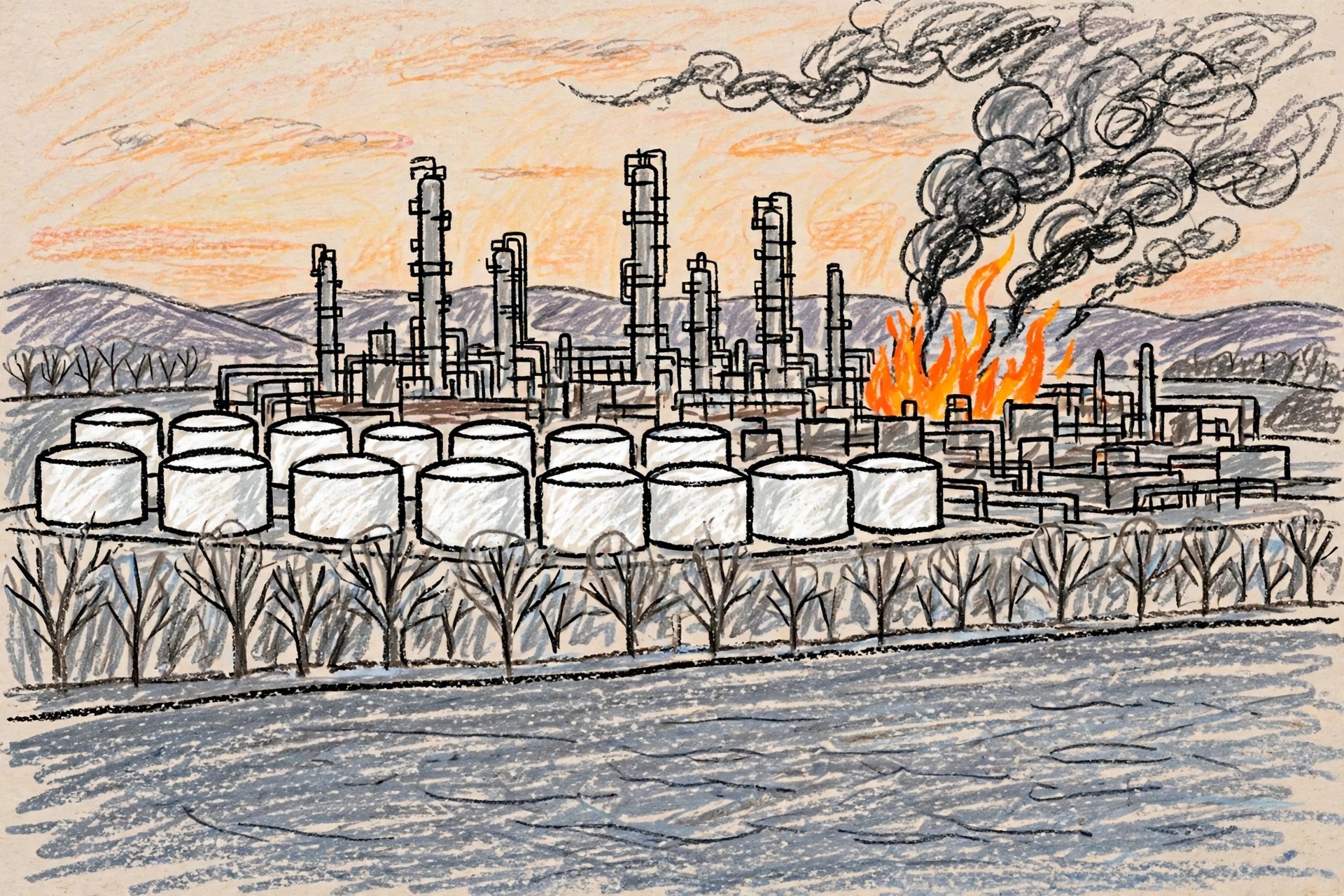
The main blow landed on Russia's Samara region, on the Volga. Governor Vyacheslav Fedorishchev said air defenses downed more than 145 drones over the region overnight, that one person was killed in the regional capital, Samara, and that the attack caused power outages and put some schools on modified timetables. Fires were reported at two Rosneft refineries — the Syzran plant and the Kuibyshev plant in Samara itself — by the monitoring channel Exilenova+ and by Astra, whose OSINT analysts identified the plants from residents' video; NASA's FIRMS satellite fire-monitoring system detected fires at both sites, the Kyiv Independent and Reuters reported. Syzran's mayor, Andrei Sovetkin, confirmed that industrial facilities in his city were struck but did not name the plant, and Governor Fedorishchev did not name the refineries either. Ukraine's General Staff had not confirmed the refinery strikes in the reporting checked; the fires rest on monitoring-channel, OSINT and satellite reporting, carried here as such.
In Novokuibyshevsk, also in Samara region, Mayor Viktoria Katkova said the attack left 70 apartment buildings, four schools, two kindergartens and a medical facility without electricity, and public traffic in the city was halted during the attack. In Rostov region, Governor Yury Slyusar said more than 50 drones were intercepted over Taganrog and seven districts — Azov, Verkhny Don, Kamensk, Myasnikovo, Neklinovo, Tsimlyansk and Sholokhov — with no casualties or damage reported; the monitoring channel Exilenova+ reported a fire at the Novoshakhtinsk oil refinery in the same region, which no official in the reporting checked confirmed. Belgorod region's governor reported 100 drones destroyed or suppressed over 24 hours and 93 attacks on the region in the same period; Kursk region's governor counted 74 drones downed over 24 hours, and Voronezh region's authorities reported 21 drones destroyed overnight with no casualties or destruction in their preliminary tally.
Civilian toll
In Zaporizhzhia, the toll from the Nov 24 early-hours attack on the Kosmichnyi district — covered in yesterday's brief — kept rising on Nov 25. Regional administration head Mykhailo Semikin put the injured at 50, including an infant. The number of injured children differs between accounts: one report of Semikin's update says eight children are among the 50, while other Ukrainian reporting of the same update says four children, and an earlier count on Nov 24 put the injured at 48, including four children. The death toll stands at two. The figures are reported here as given; the child count does not agree between accounts.
In Odesa region, an evening attack on Nov 24 killed two people. Governor Oleh Kiper said two people were killed and three more injured, including a child, with cars and private and industrial buildings hit. The State Emergency Service (DSNS), in the account carried by the Kyiv Independent, put it differently: one person killed and one injured in the Odesa district, and a child killed in the Podilskyi district — the two killed were born in 1985 and 2009, making the younger a 17-year-old. The injured counts — three in Kiper's account, one in the DSNS account — do not match, and both are reported here as given. In Kyiv, late on Nov 24, a drone struck outside a 16-storey residential building and fires broke out on the first and second floors, injuring two people, Mayor Vitalii Klitschko and the DSNS reported.
In Bila Tserkva, in Kyiv region, the overnight attack killed a man born in 1974, Kyiv Regional Military Administration head Tymur Tkachenko said. Acting Mayor Volodymyr Vovkotrub said Russian drones hit critical infrastructure and civilian businesses in the city, including the Epicentr construction hypermarket and Nova Poshta facilities; a parking-lot fire was put out, and two trucks and a commercial establishment were damaged, Tkachenko said. On the Russian side, the one death reported from the overnight wave was the person killed in Samara, reported by Governor Fedorishchev in the strikes section above; Rostov's governor reported no casualties in his region. Both sides deny deliberately targeting civilians.
Talks
The argument over who sits at the table widened on Nov 24–25. Kremlin spokesperson Dmitry Peskov said the upcoming talks in Abu Dhabi will be trilateral — Russia and Ukraine, with the United States mediating — and that European representatives will not take part, Russian media reported. That runs against what Kyiv has been saying: President Volodymyr Zelenskyy said on Nov 23 that Ukraine is ready for a four-party meeting with Europe, the United States and Russia "literally tomorrow," that partners want it held before Christmas, and that the US side had agreed to bring European representatives to the table. Ukraine's negotiator David Arakhamia has likewise said the next round should be multilateral, not trilateral, with Europe represented. Moscow has not publicly confirmed the four-party format, no date has been set, and the disagreement over European participation is open and flagged here as such.
On substance, Russian negotiator Vladimir Medinsky ruled out territorial concessions as the Abu Dhabi track wrapped up its latest round, wire summaries reported on Nov 25, and Russia continues to insist on a full Ukrainian withdrawal from the parts of Donbas it does not hold, while Ukraine rejects giving up any unoccupied territory — the same deadlock reported after the Nov 10–11 round. That round's one concrete result, a large prisoner-of-war exchange agreed in principle, still had no completed swap reported in the reporting checked. No ceasefire terms were agreed or announced by any side in the period covered.
Sources: Ukraine's Air Force (via Ukrinform) and General Staff (morning report for Nov 24–25, via Kyiv24, Ukrinform and open wires); Zaporizhzhia regional administration head Mykhailo Semikin (via Ukrainian reporting); Odesa governor Oleh Kiper and the State Emergency Service (via Reuters and Kyiv Independent); Kyiv Mayor Vitalii Klitschko; Kyiv Regional Military Administration head Tymur Tkachenko and Bila Tserkva acting mayor Volodymyr Vovkotrub (via Kyiv Independent, Kyiv Post and Ukrainian reporting); Ukrenergo (via Ukrainian reporting); ISW's Nov 24 assessment; DeepState (via Ukrainian reporting); Russia's Defense Ministry (via Interfax); Samara governor Vyacheslav Fedorishchev, Syzran mayor Andrei Sovetkin, Novokuibyshevsk mayor Viktoria Katkova, Rostov governor Yury Slyusar, and Belgorod, Kursk and Voronezh regional authorities (via Reuters, Meduza, Interfax and open wires); monitoring channels Exilenova+ and Astra (via Kyiv Independent); Kremlin spokesperson Dmitry Peskov (via Russian media) and Russian negotiator Vladimir Medinsky (via wire summaries). Each side's numbers are that side's claims, labeled as such, and disagreements are flagged where the counts differ.
Back to the briefing page — the newest brief is always there.