
📚 Learn Russian Textbook — the Amazon link that pays for this site
As an Amazon Associate, SunnyGoat earns from qualifying purchases.
Monday, November 23, 2026
Overnight strikes
Russia attacked Ukraine overnight Nov 22–23 with 153 strike drones — Shahed-type drones, 60 of them jet-powered, plus Gerbera drones and Parodiya decoys — launched from 18:00 on Nov 22 from Oryol, Kursk, Millerovo, Shatalovo and Primorsko-Akhtarsk in Russia, from occupied Donetsk, and from Hvardiiske and Chauda in occupied Crimea, Ukraine's Air Force reported via Ukrinform. By 08:00 on Nov 23, air defenses had shot down or suppressed 134 of the 153, including 42 of the jet-powered Shaheds, the Air Force said; hits were recorded at 11 locations and debris from downed drones fell at seven more, and the attack was still under way when the report was issued, so the count is preliminary. No missiles were listed in this overnight package.
The night followed a heavy day of Russian strikes on Nov 22. In Cherkasy region, a daytime drone attack on Nov 22 kept the regional air-raid alert running for almost four hours, with explosions heard in Cherkasy city as air defenses worked, public broadcaster Suspilne reported; the Cherkasy Regional Military Administration said on Nov 23 that air defenses and mobile fire groups downed nine Russian drones over the region that day, with no injuries or property damage reported. In Kyiv, drone debris from the early hours of Nov 23 fell on a warehouse in the Podil district and on the grounds of two schools in the Sviatoshyn district, Ukrainian reporting said; no casualties from the Kyiv debris were reported in the accounts checked.
A Russian jet-powered drone also crossed into Moldovan airspace twice on Nov 21 during Russian strikes on western Ukraine, Moldova's Ministry of Defense reported — entering at 11:20 local time from Troitske in Odesa region toward Purcari, leaving, then re-entering at 11:31 and exiting back toward Ukraine at 11:32, ISW reported in its Nov 22 assessment. ISW said Russian drones have repeatedly violated Moldovan airspace, most recently on the evening of Nov 17. Russia did not comment on the Moldovan report in the reporting checked.
Front line
Ukraine's General Staff reported 149 combat engagements over Nov 22. It said Russia carried out 72 airstrikes, dropping 254 guided aerial bombs, used 7,964 kamikaze drones and conducted 2,250 shelling attacks, 25 of them with multiple-launch rocket systems. The Kostiantynivka direction was the hottest, with 17 Russian attacks near Kostiantynivka and toward Novoselivka, Dovha Balka, Rusyniv Yar, Hruzke and Vilne; the Pokrovsk direction saw 15 attacks toward Chernihivka, Dobropillia, Bilytske, Krasnopodillia, Shylivka, Myrne, Serhiivka and Molodetske; the General Staff also reported seven attacks each on the Lyman and Huliaipole directions, six on the Sloviansk direction, three repelled on the South-Slobozhansky direction and two on the Orikhiv direction, and no assaults on the Kupiansk, Kramatorsk, Oleksandrivka or Prydniprovske directions. It said Ukrainian aviation, missile forces and artillery struck two areas where Russian troops and equipment were concentrated, two drone command posts and two artillery systems.
In its morning report on Nov 23, the General Staff said Russian forces lost 2,471 personnel over the past day, bringing its estimated total since the full-scale invasion to about 1,639,640, along with 1,459 drones, 70 artillery systems and five tanks. That is Ukraine's claim. Russia's Defense Ministry, in its daily account for Nov 22, said its air defenses shot down 792 Ukrainian drones in 24 hours and put Ukrainian losses far lower than the figure Ukraine claims for Russian losses; the two sides' loss figures for each other do not match, neither side publishes a matching count of its own losses, and both figures are reported here as their makers gave them.
ISW's Nov 22 assessment, working from geolocated footage, said both Ukrainian and Russian forces recently advanced southwest of Druzhkivka and southwest of Dobropillya, and that Ukrainian forces advanced within and east of Dobropillya, where Ukrainian observer Kostyantyn Mashovets said Ukrainian troops control the Stepy–Kucheriv Yar line and cleared Russian infiltration groups from Dobropillya itself. In northern Sumy region, Ukrainian sources claimed on Nov 21–22 that Ukrainian forces liberated Yablunivka, Oleksiivka and Varachyne and advanced near Basivka, Yunakivka and Andriivka; Russian sources denied the reports, saying flag-raising footage shows Russian forces control those settlements. ISW said it had seen no visual evidence strong enough to assess that control of terrain in northern Sumy region has changed — the liberation claims and the Russian denials do not agree, and both are reported here as published. Russia's Defense Ministry separately claimed on Nov 22 that Russian forces seized Sosnovyi Bir, northeast of Kharkiv city; ISW recorded no confirmed Russian advance in that area.
Ukraine strikes back
President Volodymyr Zelenskyy confirmed on Nov 23 that Ukraine sank the Russian corvette Merkury at Benghazi naval base in eastern Libya. Zelenskyy said seven Ukrainian-made naval drones carried out the operation, run by the Security Service of Ukraine with the Defense Forces; the corvette — one of Russia's newest warships, commissioned in 2023 — capsized and sank, a Ka-27 combat helicopter aboard was destroyed, and a second vessel, the cargo ship MV Angara, which Zelenskyy said Russia uses to transport weapons, was also hit. ISW's Nov 22 assessment, from geolocated footage and satellite imagery published Nov 22, had already reported fire and secondary explosions on the Project 20380 Merkury and that most of the ship had capsized and sunk; Libyan military officials affiliated with the Libyan National Army said six Ukrainian unmanned sea vehicles attacked, with two striking the corvette. Eastern Libya's authorities said the ship had stopped at Benghazi to refuel under a cooperation agreement, that port facilities were safe and operations had resumed, and that a joint investigation with Russia would follow; they said Libya is not a party to the war. Kremlin spokesperson Dmitry Peskov said on Nov 23 that Russia had "taken note" of Zelenskyy's statement and that its defense ministry was handling the matter. The drone counts — seven in Zelenskyy's account, six launched and two hitting in the Libyan officials' account — do not match exactly, and both are reported here as given.
Overnight Nov 22–23, Ukrainian drones struck oil facilities in three Russian regions: the Novoshakhtinsk oil products plant in Rostov region, the Lukoil Permnefteorgsintez refinery in Perm, and the Kaleikino oil pumping station in Tatarstan, Ukrainian and Russian reporting said. Perm governor Dmitry Makhonin said several industrial facilities were damaged and — in his updated account on Nov 23 — that one person was killed and two injured; he did not name the facilities. The Russian outlet Astra, analyzing eyewitness footage, identified the Perm site as the Lukoil refinery, with fires in its primary processing area. Rostov governor Yuri Slyusar called the attack on his region "massive," confirmed a fire caused by falling drone debris in Krasny Sulin district, and did not name the plant; Tatarstan's leader Rustam Minnikhanov confirmed the attack on his region, and no casualties were reported at the Tatarstan site. Russia's Defense Ministry said nearly 200 Ukrainian drones were shot down overnight, naming Tatarstan, Perm and Rostov among the regions. Which exact installations burned in Rostov region — the plant itself or a neighboring fuel depot — was still uncertain in the reporting checked, and the accounts are reported here as their makers gave them.
Two further reported Ukrainian operations from Nov 21–22 remain partly unconfirmed. In Krasnodar Krai, geolocated footage published Nov 22 showed smoke rising in Krasnodar city, and the Russian opposition source Astra assessed that Ukrainian strikes likely damaged the regional Rosgvardia (National Guard) headquarters; the Krasnodar Krai Operational Headquarters instead said a drone strike damaged residential infrastructure in Afipsky, southwest of the city — the two accounts point to different sites and are reported here as published. In Kaliningrad region, Russian air defenses fired near the Baltic Fleet port of Baltiysk on Nov 21 and air alarms sounded across the region; some sources reported a Ukrainian drone attack, but ISW said it had collected no sufficient evidence of one, no drone debris or damage had been shown, Russia's Defense Ministry's nightly report did not mention Kaliningrad, and Kaliningrad governor Alexey Besprozvannykh attributed the Nemansky district alert to a "suspicious object" from the direction of Lithuania that specialists then judged "no threat." Ukraine's StratCom noted the sirens and said "Kaliningrad is no longer off limits," without explicitly confirming a Ukrainian strike. What the Baltiysk air defenses were firing at remains unconfirmed.
Civilian toll
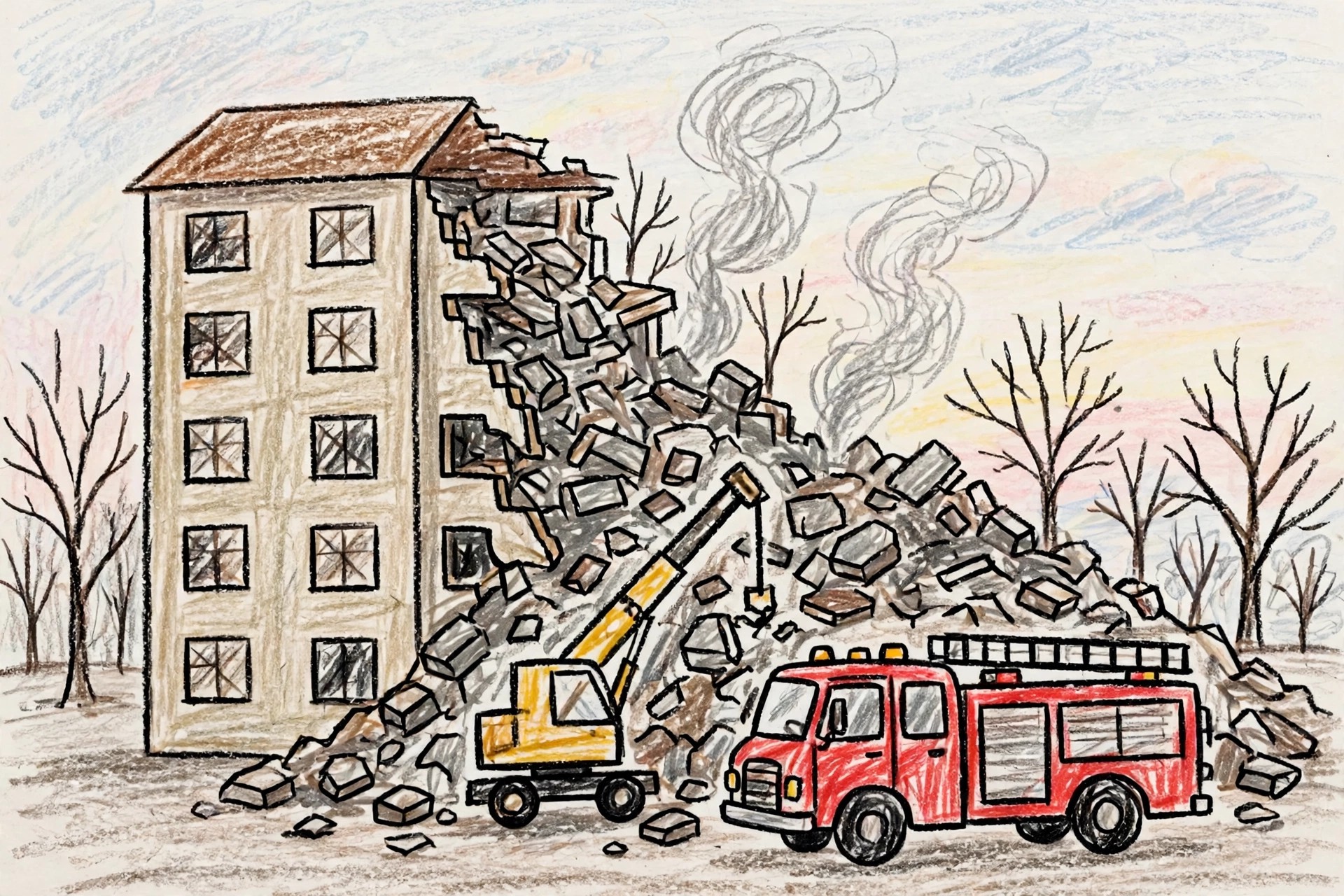
The death toll from the Nov 22 drone strike on a five-storey apartment building in Dymer, in Kyiv region's Vyshhorod district, rose through Sunday night and into Monday morning. The drone hit at about 05:00 on Nov 22 and destroyed a section of the building from the first floor to the fifth, damaging a neighboring kindergarten and a shop, Ukraine's State Emergency Service and Interior Ministry said. By Monday morning Nov 23, Kyiv region police and regional administration head Tymur Tkachenko put the toll at 11 people killed, including a young girl, with two people still missing and seven injured, including two children. Rescuers pulled two survivors out alive hours apart: a seven-year-old boy freed on Sunday evening after almost 14 hours under the rubble, and a 79-year-old woman found at about 03:28 on Monday. More than 130 rescuers worked at the site, with the search repeatedly interrupted by new air-raid alerts, President Zelenskyy said. Kyiv region declared Monday, Nov 23, a day of mourning. The counts moved repeatedly as bodies were recovered — three confirmed dead on Sunday morning, four by Sunday evening in Zelenskyy's account, 11 by Monday morning — and the later regional figures are the ones carried here.
Elsewhere in Kyiv region on Nov 22, a Russian drone struck a grocery store in Vyshneve, in Bucha district, killing three people and injuring 15, including three children, Vyshneve mayor Illia Dikov and regional officials said; President Zelenskyy's own account of the same strike gave three killed and 13 injured — the injury counts differ between the mayor's and the president's statements, and both are reported here as given. A separate strike on a private home in the Bila Tserkva district killed one person and set the house ablaze, regional authorities said. In Sumy region, Russian attacks on Nov 22 killed a 15-year-old boy and injured nine civilians, damaging homes, public buildings, a post office and a railway station, Ukrainian regional reporting said. In Sloviansk, in Donetsk region, a Russian airstrike with FAB-250 bombs on the night of Nov 22 injured five people and damaged a university building, a medical facility and homes, Ukrainian reporting said. In Dnipropetrovsk region, Russian forces struck a power substation on Nov 22, Prime Minister Sergiy Koretsky said. Russia's Defense Ministry does not describe the Dymer or Vyshneve strikes in these terms in the reporting checked; both sides deny deliberately targeting civilians.
On the Russian side, one person was killed in the overnight drone attack on Perm region, governor Dmitry Makhonin said, with two injured — the same incident covered in the strikes section above. In Bryansk region, governor Egor Kovalchuk said a Ukrainian kamikaze drone struck a civilian car on Nov 22, killing its 50-year-old driver, and that another drone injured a 39-year-old cyclist in the village of Churovichi, who was hospitalized, RIA Novosti reported. In occupied Luhansk region, Kremlin-installed leader Leonid Pasechnik said Ukrainian attacks killed a cyclist and wounded three other people on Nov 22. Each of these is reported as its own side's officials gave it.
Talks
The Kremlin said on Nov 23 that a new round of trilateral talks between Russia, Ukraine and the United States could take place in Abu Dhabi, in the United Arab Emirates, and is expected soon, though no dates have been confirmed. The last trilateral round was held in Abu Dhabi on Nov 10–11 and made no progress on a ceasefire, territorial issues or long-term security guarantees, in the accounts carried with the Kremlin's statement. No Ukrainian or US confirmation of a new Abu Dhabi round, and no date or venue beyond the Kremlin's statement, had been published in the reporting checked for this brief.
President Zelenskyy's Nov 21 proposal for temporary, localised ceasefires to evacuate civilians from 15 settlements along the Dnipro River in occupied Kherson and Zaporizhia regions — carried in yesterday's brief — had still drawn no Kremlin response in the reporting checked. The weekend's strikes also reached the talks indirectly: Kremlin spokesperson Dmitry Peskov, asked on Nov 23 about the sinking of the Merkury off Libya, said Russia had "taken note" of Zelenskyy's statement and that the defense ministry was handling it, without announcing any change to the talks track. A summit between US President Donald Trump, Russian President Vladimir Putin and Chinese President Xi Jinping in the days before the weekend likewise made no progress toward ending the war, CNN reported. No ceasefire terms were agreed or announced by any side in the period covered.
Sources: Ukraine's Air Force (via Ukrinform) and General Staff (via Ukrinform, UNN and EMPR); Ukraine's State Emergency Service, Interior Ministry, Kyiv region police and administration head Tymur Tkachenko, Vyshneve mayor Illia Dikov, Cherkasy Regional Military Administration and Suspilne, and Prime Minister Sergiy Koretsky; President Volodymyr Zelenskyy's statements on the Dymer rescue and the Benghazi operation; ISW's Nov 22 assessment; Moldova's Ministry of Defense (via ISW); Russia's Defense Ministry (via RIA Novosti, Sweden Herald and open wires); Perm governor Dmitry Makhonin, Rostov governor Yuri Slyusar, Tatarstan leader Rustam Minnikhanov, Bryansk governor Egor Kovalchuk and Kaliningrad governor Alexey Besprozvannykh; Krasnodar Krai Operational Headquarters and the Russian outlet Astra; eastern Libya's authorities and Libyan National Army officials (via ISW and open wires); Kremlin spokesperson Dmitry Peskov; and Kremlin-installed Luhansk leader Leonid Pasechnik. Each side's numbers are that side's claims, labeled as such, and disagreements are flagged where the counts differ.
Back to the briefing page — the newest brief is always there.