As an Amazon Associate, SunnyGoat earns from qualifying purchases.
War Briefing
Wednesday, November 18, 2026
Overnight strikes
Russia attacked Ukraine overnight Nov 17–18 with 141 strike drones, including 73 reactive (jet-powered) drones, launched from the Orel and Millerovo areas in Russia and from Chauda and Hvardiiske in occupied Crimea, Ukraine's Air Force reported. By 08:00 on Nov 18, air defenses had shot down or suppressed 126 of the drones, including 59 reactive ones, the Air Force said; hits were recorded at seven locations, and several drones were still in the air with combat work continuing when the report was issued.
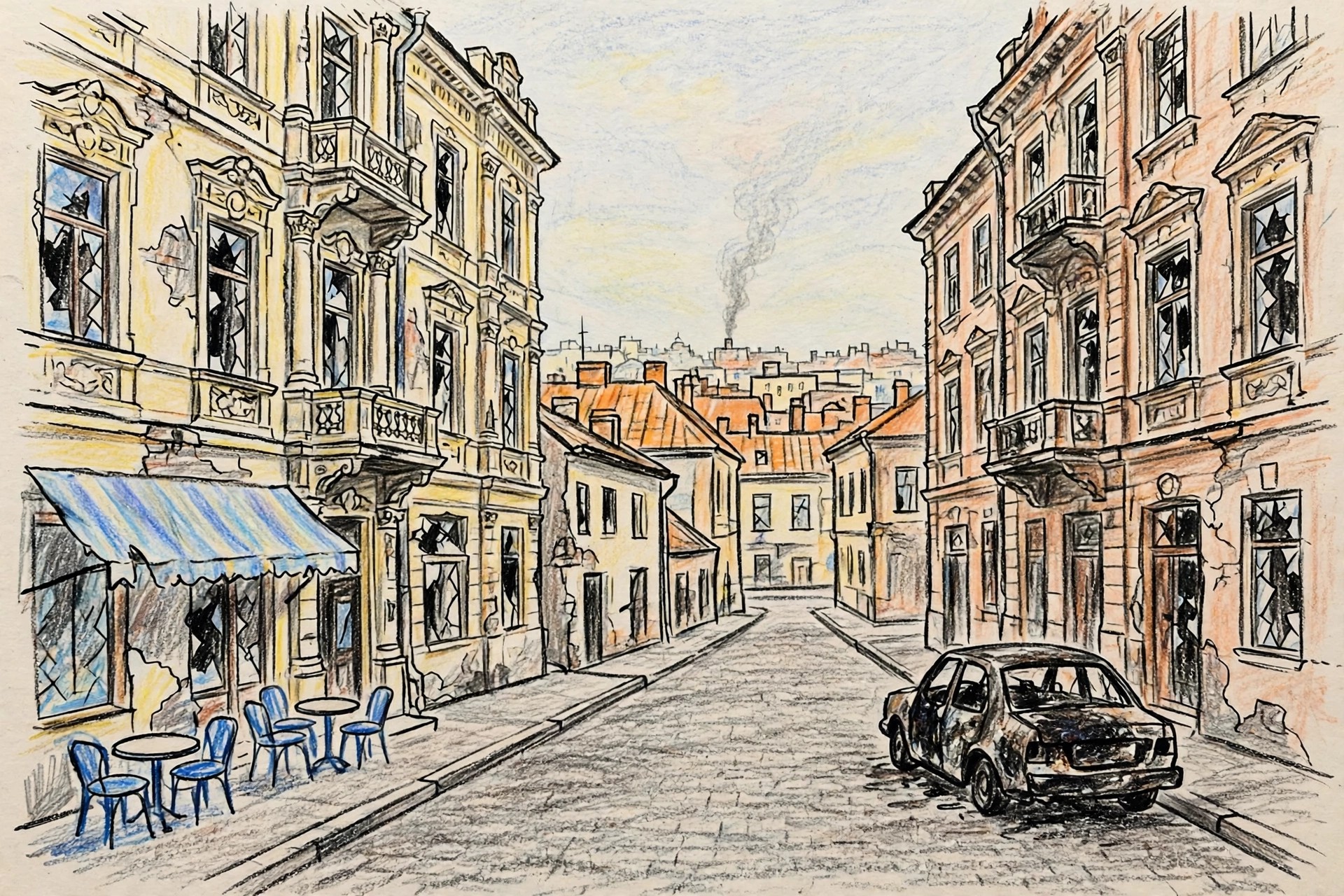
On the morning of Nov 18, Russian drones struck the historic centre of Odesa in three successive waves, regional governor Oleh Kiper said, killing four people and injuring at least seven. Serhiy Lysak, head of the city's military administration, said a second strike damaged a residential building and an educational institution; Kiper said windows in residential buildings, cafes and shops were broken, a car was set on fire and several other vehicles were damaged. The toll rose through the morning's reporting — the Kyiv Independent at one point reported three killed and seven injured, while Reuters, citing regional officials, reported four killed — so the counts in different reports do not all match.
In Dnipro, the overnight attack damaged Austria's Honorary Consulate, apartment buildings, a private house, a dormitory, a recreation park and infrastructure, Kyiv Post reported; six people were injured, five of them hospitalized. Austria's Foreign Ministry condemned the strike and confirmed no consulate employees were injured. In Rivne region, a Russian strike on the morning of Nov 18 cut power to more than 80 settlements in the north of the region, with energy workers restoring supply and no casualties reported, regional authorities said. Ukraine's Energy Ministry said fresh outages were recorded in eight regions — Dnipropetrovsk, Donetsk, Zhytomyr, Zaporizhzhia, Kharkiv, Sumy, Rivne and Cherkasy — with emergency power cuts in Kharkiv, Sumy and Poltava regions, and First Deputy Energy Minister Artem Nekrasov said Russian forces have launched more than 1,000 strikes on energy facilities since September.
Russia's Defense Ministry gave its own account of its overnight strikes on Nov 18: it said Russian forces struck infrastructure at Ukraine's Port of Izmail used for unloading and storing military cargo for Ukraine's armed forces, and struck a cargo vessel heading for the Port of Pivdennyi (Yuzhny) that it said was carrying dual-use cargo for Ukraine's forces. The ministry named no vessel, and no independent confirmation of that ship claim appeared in the reporting checked for this brief. Ukraine's Foreign Minister Andrii Sybiha said on Nov 16 that Russian strikes have damaged at least 1,600 port facilities and 260 civilian ships — a civilian tally that does not match the ministry's military-cargo framing, and both accounts are reported here as each side gave them.
In Kyiv, the North and South bridges hit by Russian ballistic missiles on Nov 16 were partially reopened on Nov 17, Kyiv authorities said: limited traffic was moving in one direction over the Southern Bridge, public and special vehicles could cross the Northern Bridge in both directions, and tram and trolleybus services resumed. President Volodymyr Zelenskyy said four ballistic missiles struck the Southern Bridge and three struck the Northern Bridge, ISW reported; a Russian milblogger claimed around 30 ballistic missiles were launched at the two bridges. Those missile counts do not match. Russian forces also struck the Preobrazhensky Bridge in Zaporizhzhia City on Nov 16, reportedly with a Geran-4 strike drone, according to geolocated footage cited by ISW. On the morning of Nov 18, Russian drones also attacked Kyiv, with debris falling in open areas in the Darnytskyi district and casualty and damage information still being clarified, Ukrainian reporting said.
Front line
Ukraine's General Staff reported 165 combat engagements over the past day, reported on Nov 18, the 1,729th day of the full-scale invasion, with the heaviest fighting again on the Pokrovsk direction. It said Russia launched two missile strikes and 87 airstrikes, dropped 220 glide bombs, used 6,990 kamikaze drones and conducted 2,418 shelling attacks over that day.
The General Staff also said Russian forces lost 1,970 personnel over the past day, bringing its estimated total since the full-scale invasion to about 1,629,010, along with 1,223 operational-tactical drones, 34 artillery systems and 375 vehicles and tankers. The daily loss list included one bridge — the Kerch Bridge, appearing in Ukraine's official tally for the first time, UNITED24 Media noted. That is Ukraine's claim; Russia does not publish a matching daily count.
ISW's Nov 17 assessment said neither Russian nor Ukrainian forces advanced on Nov 17. Russia's Defense Ministry claimed on Nov 17 that its Eastern Grouping of Forces had seized Zalyvne, southwest of Oleksandrivka; ISW said it observed no evidence that Russian forces advanced there and described the ministry's advance claims in that sector as heavily aggrandized. The claim and the assessment do not match. Near Kupyansk, Ukrainian Joint Forces Task Force spokesperson Colonel Viktor Trehubov said on Nov 17 that Russian infiltration groups northwest of the city have shrunk from six people to individual servicemembers because of personnel losses.
The sides' territory totals for 2026 still differ widely. Ukraine's Air Assault Forces commander, Major General Oleh Apostol, said two Ukrainian offensive operations this year retook more than 800 square kilometres. Russia has claimed its forces took 6,500 square kilometres of Ukrainian territory this year. ISW estimated the actual figure at a net Russian gain of only 73 square kilometres. All three figures are reported here as their makers gave them; they cannot all be right.
On Kostiantynivka in Donetsk region, the Kremlin said Russian President Vladimir Putin and US President Donald Trump may discuss a proposed humanitarian mission to evacuate people from the city at their Shenzhen meeting on Nov 19. Ukraine's General Staff said fighting in the city continued and rejected Russian claims that Kostiantynivka had been captured.
Ukraine strikes back
A day after Ukraine's strike collapsed the Kerch Bridge's road section, the state of the crossing was clearer — and the two sides' descriptions still differed. ISW's Nov 17 assessment, citing Ukraine's General Staff and the SBU, said the automobile sections were completely collapsed and the railway section damaged; the General Staff said the metal arch and the road span beneath it were destroyed and no vehicle can cross. Russia's Transport Ministry said rail and road traffic was suspended after the strike and later resumed along one railway track; Crimea's Russian-installed head Sergei Aksyonov said railway service between Crimea and Taman had resumed and passengers without vehicles could use the ferry. Russian officials have not formally confirmed that the arch collapsed. Kremlin spokesman Dmitry Peskov, who had described the damage from the Nov 16 strike as minor, said on Nov 17 there is "no doubt that the bridge will be restored" and that it "will be even better than before," with a repair plan and timeline being prepared but no date given. Deputy Prime Minister Marat Khusnullin chaired a government commission on Nov 17 to assess the damage, begin reconstruction and discuss alternative routes. A Ukrainian military expert, retired navy captain Andrii Ryzhenko, estimated rebuilding the road span and arch could take more than a year; Moscow has given no timeline of its own.
Russia's Defense Ministry claimed its forces intercepted 4,305 Ukrainian drones and 16 Flamingo cruise missiles within a 48-hour span from about noon on Nov 15, across Russia and occupied Ukraine, ISW reported — against a daily average of 882 drones the ministry reported between Nov 7 and 13. That is Russia's claim and could not be independently verified. ISW assessed that Russia will now have to rely more heavily on the land route into Crimea along the M-14 and M-18 highways; Rostov region governor Yury Slyusar claimed on Nov 17 that Ukrainian forces struck a section of that same M-14 Rostov–Crimea highway, near a bridge over the Mius River in Neklinovskyi Raion, on the night the Kerch road span fell, and Kherson occupation governor Vladimir Saldo claimed Russia's Defense Ministry is strengthening security along the land route.
Overnight Nov 17–18, drones attacked the Afipsky and Ilysky oil refineries in Russia's Krasnodar Krai, causing fires at both plants, Ukrainian monitoring channels Exilenova+ and Supernova+ reported, citing local sources. Krasnodar Krai's regional operational headquarters gave a narrower account, via Meduza: it said fires broke out at two facilities after drone debris fell, without naming the facilities, that four people were injured in the Seversky district — where both refineries are located — and that drone fragments were found at nine locations, including private home courtyards and streets. The Kyiv Independent said it could not independently verify the reported strikes or damage at either refinery, and Ukraine's military did not immediately confirm the strikes. The refineries' names rest on the monitoring channels and local reporting; the regional headquarters confirmed fires and injuries but not which plants were hit.
On the Bashkortostan strikes of Nov 16–17, Ukraine's Unmanned Systems Forces said Ukrainian forces also struck the Bashneft-Ufaneftekhim oil refinery in Ufa, in addition to the Salavat complex the General Staff reported. Bashkortostan emergency officials acknowledged drone strikes on industrial zones in Salavat and Ufa but claimed all plants were operating normally without critical damage — which does not match Ukraine's account of hits and fires. ISW also reported that Russian Deputy Prime Minister Alexander Novak instructed Russian oil companies to increase production of lower-grade gasoline and continue importing gasoline amid Ukraine's continued strike campaign against Russian refineries.
Civilian toll
Russian attacks killed five people and injured 15 across Ukraine over the past day, local authorities reported on Nov 18, the Kyiv Independent said — a tally compiled before, and not including, the Nov 18 morning strikes on Odesa's centre reported above, so the day's totals in different reports differ by the window they cover. In Donetsk region, Governor Vadym Filashkin reported four deaths: two in Sloviansk from drone and FPV drone strikes, one in Shabelkivtsi from an FPV drone strike, and one in Yasnohirka from a glide bomb strike. In Kharkiv region, Governor Oleh Syniehubov said one person was killed and five injured in attacks on 16 settlements using drones, glide bombs and FPV drones, and energy infrastructure was damaged in Kyiv, Mykolaiv and Rivne regions in the same reporting.
In Zlatopil in Kharkiv region, a Russian strike on a market on the morning of Nov 18 injured at least 11 people, including an 11-year-old boy, and set trading stalls on fire, Syniehubov said; a later report counted 12 people affected — 11 injured and one person with an acute stress reaction. In Zaporizhzhia region, a large Russian attack on Nov 17 killed two people and injured dozens, regional reporting said; a combined strike on industrial sites in Zaporizhzhia City on the morning of Nov 17 killed a man and a woman and injured 38, with factories and warehouses damaged, fires, and damage to energy infrastructure causing widespread power outages.
In Sumy region, Russian forces carried out nearly 50 strikes over the past day, injuring civilians, damaging housing and civilian infrastructure and destroying several houses; two police officers were wounded when a Russian drone attacked a police car in Hlukhiv, regional reporting said. In Kherson region, Russian forces shelled more than 40 settlements over the past day with drones, airstrikes and artillery, damaging civilian, social and critical infrastructure; no civilian casualties were reported there, and two people were evacuated from liberated communities.
Beyond Ukraine's borders, Moldova's Defense Ministry reported that seven Russian drones violated Moldovan airspace on the evening of Nov 17, including one that flew directly over the capital, Chisinau, President Maia Sandu said; five drones crashed near Cheltuitori, Pohorniceni, Pogrebeni, Cuhurestii de Jos and Baxani, a possible sixth crashed in Ocnița Raion, and a seventh disappeared from radar near Leova, toward the Romanian border, ISW reported, citing the ministry. In Russia's Krasnodar Krai, the regional operational headquarters said four people were injured in the Seversky district in the overnight drone attack reported above. Both sides deny deliberately targeting civilians.
Two longer counts also landed this week. Ukraine's Interior Minister Ivan Vyhivskyi reported that search and rescue operations at Komyshuvakha in Zaporizhzhia region, after Russia's Nov 2 airstrikes on a humanitarian aid site, have ended with 72 people killed, four still missing and four in hospital; Vyhivskyi said Russian forces conducted 11 airstrikes on the settlement, including nine directly against the site of the rescue operations. And UN monitoring reported that Russian attacks killed at least 372 civilians in Ukraine in October 2026 and injured 1,981 — the highest October death toll since the full-scale invasion began, and 95% higher than in October 2025.
Talks
Two meetings now sit on the same day, Thursday, Nov 19. In Berlin, the Coalition of the Willing holds its summit, hosted by German Chancellor Friedrich Merz with France and Britain; the German government expects more than 20 heads of state and government, and the coalition itself includes more than 30 countries. US envoys Steve Witkoff and Jared Kushner are expected in Berlin on Nov 19 to meet Ukrainian and European representatives, a US official said, for talks on security guarantees for Ukraine and a postwar economic reconstruction plan, and to prepare the next round of multilateral negotiations; the German government did not initially confirm the US envoys' participation when asked. Kushner said progress was being made toward an agreement, though important challenges remain, and that the envoys had discussed facilitating direct contact between Europe and Russia. In Shenzhen, China, US President Donald Trump, Russian President Vladimir Putin and Chinese President Xi Jinping are meeting on the sidelines of the APEC summit over Nov 18–19, the same day as Berlin; the Kremlin's stated possible agenda item there is the Kostiantynivka humanitarian mission reported above, and no broader confirmed agenda on the war appeared in the reporting checked for this brief.
Moscow's stated terms did not move. Russian Deputy Foreign Minister Sergei Ryabkov said on Nov 17 that NATO membership for Ukraine is "categorically unacceptable" for Russia and that there is no talk of European participation in future peace negotiations, ISW reported. Foreign Minister Sergei Lavrov said the same day that European officials are trying to "squeeze" into the negotiations to build a European security architecture directed against Russia, and that Russia remains committed to its original 2021 ultimatums. ISW noted those statements directly contradict the proposals Witkoff and Kushner have pushed for, and that Kremlin officials have intensified their refusal to include European representatives despite recent US calls to include them. That refusal sits unresolved against the Berlin meeting's whole premise.
Follow-through from the Nov 17 Ramstein meeting continued. Canada's Defense Minister David McGuinty announced a new package at the meeting, reported on Nov 18: an additional C$45 million for the Czech Ammunition Initiative, bringing Canada's total for that initiative to over C$500 million, supporting extended-range ammunition and AIM-7, R-73 and R-27 air-defence missiles; up to 1.6 million rounds of surplus 20 mm ammunition to counter attack drones; C$80 million for MX-15D sensor systems; winter equipment; and about 250,000 individual rations. Canada said its military aid to Ukraine since 2022 now exceeds C$8.5 billion. At the same meeting, Zelenskyy proposed that partners transfer available Patriot and IRIS-T interceptors to Ukraine now, with Ukraine providing newer missiles it has already ordered as they are produced, to shorten delivery queues and replenish depleted stocks; Sweden's Defense Minister Pål Jonson said Ukraine needs another 18–24 months to build its own anti-ballistic capabilities, with the FREYJA system to be tested this winter.
The allies also disagreed in public over Ukraine's deep strikes. US Deputy Defense Secretary Elbridge Colby said at Ramstein that Ukraine has liberated more territory than Russia has captured for two consecutive months, but criticized Ukrainian long-range strikes on Russian infrastructure as ineffective; Germany's Defense Minister Boris Pistorius rejected that criticism, and Britain's defence secretary said the deep strikes had helped degrade Russia's war machine, the Kyiv Independent reported. That disagreement — strikes as ineffective against strikes as degrading — is unresolved among Ukraine's own backers.
Sources: Ukraine's Air Force and General Staff (via Ukrinform, Interfax-Ukraine, h.ua and open wires); Odesa governor Oleh Kiper and Odesa city military administration head Serhiy Lysak (via Reuters); Kyiv city authorities on the bridge reopenings; Ukraine's Energy Ministry and First Deputy Minister Artem Nekrasov; Donetsk governor Vadym Filashkin, Kharkiv governor Oleh Syniehubov and Ukraine's Zaporizhzhia, Sumy and Kherson regional administrations (via the Kyiv Independent and h.ua); ISW's Nov 17 assessment; Moldova's Defense Ministry and President Maia Sandu (via ISW); UN humanitarian monitoring (via h.ua); Russia's Defense Ministry (via QNA and open wires), Transport Ministry, Kremlin spokesman Dmitry Peskov, Deputy Prime Minister Marat Khusnullin, Rostov governor Yury Slyusar, Crimea head Sergei Aksyonov, Krasnodar Krai's regional operational headquarters (via Meduza) and Bashkortostan emergency officials (via ISW); Canada's Department of National Defence; and reporting on the Berlin and Shenzhen meetings via Axios, AFP and open wires. Each side's numbers are that side's claims, labeled as such, and disagreements are flagged where the counts differ.