As an Amazon Associate, SunnyGoat earns from qualifying purchases.
War Briefing
Tuesday, November 17, 2026
Overnight strikes
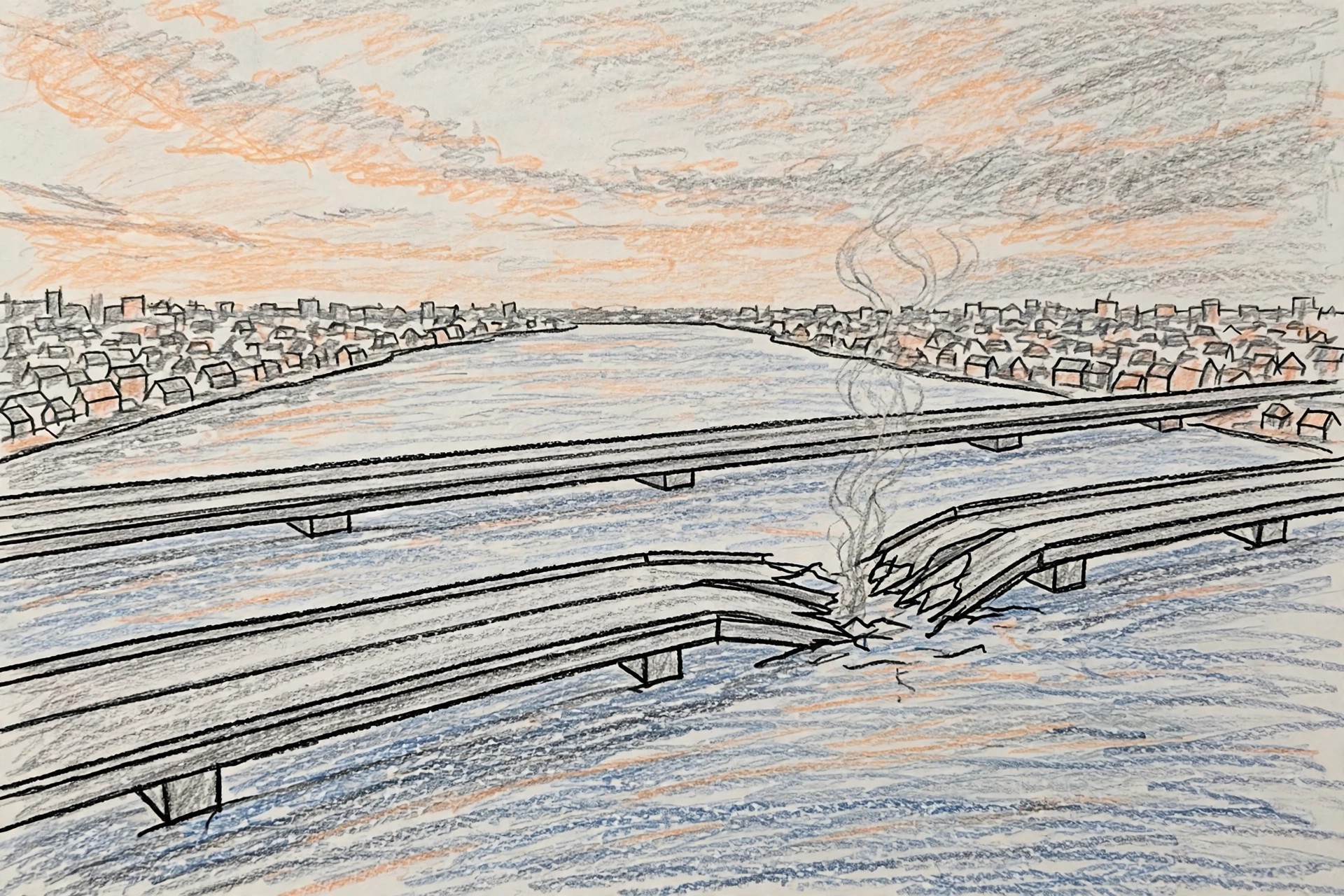
Late on Nov 16, Russian ballistic missiles struck Kyiv's North and South bridges over the Dnipro River, Kyiv Mayor Vitali Klitschko said. Air defense began operating over the capital at 23:34 on Nov 16, the mayor reported, and traffic on both bridges was suspended while experts inspected the damage. At least two people were killed in Kyiv in the overnight attack, Ukrainian officials said, and fires and damage to other infrastructure were reported in four districts of the capital. The full extent of the damage to either bridge had not been established in the reporting checked for this brief.
Explosions were also reported the same night in Smila, Kharkiv, Zaporizhzhia, Dnipro, Cherkasy and Pavlohrad, the Kyiv Independent reported. Open reporting of Ukraine's Air Force figures put Russia's overnight wave at missiles plus more than 300 drones, with air defenses shooting down 211 hostile targets; a fuller Air Force breakdown had not appeared in the reporting checked for this brief.
Russia's Defense Ministry gave a different account of its own strike: it said its forces overnight carried out a major strike with land- and air-based precision weapons and drones on Ukraine's military-industrial facilities and its energy, transport and port infrastructure, and on vessels used by Ukraine's armed forces. The ministry did not, in that account, describe the Kyiv bridges as civilian crossings; Kyiv's account is that two of the capital's main road bridges were hit. Those framings do not match, and both are reported here as each side gave them.
President Volodymyr Zelenskyy had warned earlier on Nov 16 that Ukrainian intelligence expected Russia to launch major strikes that evening and into Tuesday, and he has accused Russia of trying to divide Ukraine along the Dnipro. Nuclear safety regulators from 38 countries said on Nov 16 that the risk of a nuclear accident in Ukraine is rising as Russian attacks threaten the electricity system, and called on Moscow to stop striking energy infrastructure, the Kyiv Independent reported.
Front line
Ukraine's General Staff reported 135 combat engagements over the day reported on Nov 17, the 1,728th day of the full-scale invasion, with the heaviest fighting on the Pokrovsk direction. It said Russia launched two missile strikes and 90 airstrikes, used 9,018 kamikaze drones and conducted 2,284 shelling attacks over that day, and that Ukrainian aviation, missile forces and artillery struck two Russian troop concentrations, a UAV control point and two artillery systems.
The General Staff also said Russian forces lost 1,620 personnel over the past day, bringing its estimated total since the full-scale invasion to about 1.627 million, along with substantial losses of artillery, armored vehicles and drones. That is Ukraine's claim; Russia does not publish a matching daily count, and the General Staff's figures remain subject to clarification.
ISW's Nov 16 assessment said Ukrainian forces recently advanced northeast of Sumy City, northeast of Kharkiv City and west of Orikhiv. ISW also assessed Ukraine's strike on the Kerch Strait Bridge on the night of Nov 15–16 as part of a systematic campaign to deny Russian forces the use of major supply routes via occupied Crimea, and said Ukrainian forces continued their long-range strike campaign against Russian oil and petrochemical infrastructure.
On Starshield, ISW reported a shift in the accounts: Ukrainian officials continue to report speed restrictions on Starshield-equipped drones, and SpaceX reportedly acknowledged ongoing issues affecting Starshield in Ukraine but described the degraded functionality as a technical issue. Earlier Ukrainian reporting had SpaceX saying no restrictions were in place. The practical effect, ISW said, is unchanged: the restrictions are allowing Russian forces to continue strikes against Ukrainian energy infrastructure. No new Russian Defense Ministry claim of a captured settlement appeared in the reporting checked for this brief.
Ukraine strikes back
For the second night in a row, Ukraine struck the Crimean (Kerch) Bridge overnight Nov 16–17, and this time a section of the road deck fell into the sea, according to images published by the Kyiv Independent showing a section of roadway missing between two supports and a main support arch collapsed. Russia's Transport Ministry confirmed road and rail traffic was suspended while specialists assessed the damage, and said its preliminary information indicated no casualties on the bridge itself. The bridge had reopened to a single lane on Monday evening after the previous night's strike had shut it for roughly 17 hours.
President Zelenskyy confirmed the strike on Nov 17 and described it in detail: the attack was the seventh stage of an operation carried out over several weeks, developed with the SBU and the General Staff, in which Ukrainian forces first knocked out air defenses, radars and electronic-warfare equipment. At the final stage, he said, Palianytsia drones struck the road section, while Neptune missiles and Ruta and FP-5 drones struck the railway section, and an FP-5 Flamingo missile carried out a guided strike. Defense Minister Yevhenii Khmara said the strike was carried out exclusively with Ukrainian-made weapons. Petro Andriushchenko, head of Ukraine's Centre for the Study of Occupation, said the fallen road arch had dropped into the Kerch–Yenikale Canal, blocking navigation between the Black Sea and the Sea of Azov; the extent of the damage to the rail deck had not been established.
Russia's account differs in framing and in detail. Crimea's Russian-installed head Sergei Aksyonov said the bridge was attacked again and traffic was suspended, and Russia's Investigative Committee confirmed the bridge was attacked by drones on both days and sustained damage, calling it a terrorist act by Ukrainian armed groups. Russian officials have not given their own account of a collapsed road section; the collapse rests on the published images and Ukrainian accounts, which Russian officials had not confirmed in the reporting checked for this brief.
It was also a second straight record night by Russia's own count. Russia's Defense Ministry claimed its air defenses intercepted 1,441 Ukrainian drones overnight Nov 16–17, above the 1,336 it claimed the night before. Reports of the same ministry statement put the attack across 20, 21 or 22 regions, plus occupied Crimea and the Black Sea and Sea of Azov — the regional count differs between reports. Moscow Mayor Sergei Sobyanin said about 800 drones headed toward the Moscow region between 17:00 on Nov 16 and 07:00 on Nov 17, with 321 shot down on the approach to the capital, and Rosaviatsiya imposed temporary flight restrictions at all four Moscow international airports: Vnukovo, Domodedovo, Zhukovsky and Sheremetyevo. The 1,441 figure is Russia's claim and could not be independently verified; Ukraine did not give its own total for the night.
Ukraine's General Staff said Ukrainian forces struck the Gazprom Neftekhim Salavat oil refinery and petrochemical complex in Russia's Bashkortostan region overnight, about 1,500 km from the Ukrainian border by the General Staff's account (about 1,300 km in other reporting — the distance figures differ), with explosions heard and a fire at the site; monitoring channels and the Russian outlet ASTRA carried footage of multiple fires and thick smoke. Bashkortostan's State Committee for Emergency Situations gave a different picture: it said drones attacked industrial zones in Ufa and Salavat, air defenses shot down more than 50 drones, all plants were operating as normal and there was no critical damage. Those two accounts — a plant hit and burning, and no critical damage — do not match. Fires were also reported at a 330 kV substation near Kursk in OSINT and regional reporting; that report had not been officially confirmed in the reporting checked.
Civilian toll
In Kyiv, at least two people were killed in the overnight Nov 16–17 attack that hit the North and South bridges, Ukrainian officials said, with damage and fires in four districts and water and heating cut to parts of the capital. The bridges carry some 600,000 vehicles a day, as well as trains and the metro, and their closure brought much of the city to a standstill on Tuesday, with major traffic jams on both banks.
In Zaporizhzhia region, Russian forces carried out 864 strikes across 55 populated areas on Nov 16 — a missile attack on Zaporizhzhia, 18 airstrikes, 673 drone attacks and 171 artillery strikes — killing four people and injuring eight, regional authorities said, with damage to infrastructure, housing and vehicles.
In Kharkiv region, Russian strikes over the past day killed at least two people and injured 17, regional reports said, damaging homes, businesses, vehicles and postal and electrical infrastructure; the reports themselves note the overall casualty figures differ between accounts. In Kherson region, Russian forces shelled 34 settlements over one day, killing one person and injuring three, regional authorities said.
In Crimea, Aksyonov said two people were killed in a drone attack in the Lenin district of the peninsula, near Kerch, on the morning of Nov 17. That toll is the Russian-installed administration's account and had not been independently confirmed; it is separate from the Transport Ministry's statement that there were no casualties on the bridge itself. A driver was also reported wounded when a drone attacked a car near Navlya in Russia's Bryansk region, in local reporting that had not been independently confirmed. Both sides deny deliberately targeting civilians.
Talks
The 37th meeting of the Ukraine Defense Contact Group — the Ramstein Group — met in Brussels on Nov 17, co-chaired by Germany and the United Kingdom, with air defense as Ukraine's stated priority. Germany's Defense Minister Boris Pistorius announced a $300 million German contribution to NATO's PURL program, which funds US weapons purchases for Ukraine — the fifth PURL package Germany has joined, focused on PAC-2 and PAC-3 missiles for Patriot systems, which Pistorius said Ukraine is acutely short of. Germany and Norway would also sponsor a further PURL package, he said, and Berlin would provide new radars, drones and ammunition for Ukraine's F-16 jets. Zelenskyy had said on Nov 15 that the Ramstein meeting "must deliver results," naming Patriot and NASAMS air defenses as Kyiv's priorities.
On the negotiating track, Zelenskyy said in his Nov 16 evening address that the Ukrainian, American and European negotiating teams held another discussion that day, with US envoys Steve Witkoff and Jared Kushner joining online, and Europe represented for the first time by its full negotiating group — France, Germany, the United Kingdom, Italy, Poland, the European Commission, the European Council and a NATO representative. The discussion was difficult, he said, but the sides agreed to meet in Berlin as part of the Coalition of the Willing and work out concrete joint steps. A date for the next round of US-mediated Russia–Ukraine talks had not been set in the reporting checked for this brief.
Finland's President Alexander Stubb urged European leaders on Nov 17 to engage directly with Russian President Vladimir Putin, telling the Financial Times that outsourcing engagement with Russia to the United States for so long was "irresponsible," that Europe now has a framework and should deliver the same message directly, and that Putin is "ready to engage with Europe," by his account. Moscow's account does not match that readiness: Kremlin aide Yuri Ushakov said on Nov 16 that Russia has not agreed to European participation in the negotiations, and that several more rounds of trilateral Russia–Ukraine–US talks could come first. That disagreement — Europe ready and Putin willing, against Moscow saying it has not agreed — is unresolved.
On NATO, the positions restated this week still do not meet. A senior Russian foreign ministry official said on Nov 17 that Russia would categorically not accept Ukraine joining NATO, Interfax reported. Ukraine's side, restated by Zelenskyy after the Abu Dhabi talks, is that a US suggestion of NATO membership in exchange for a withdrawal from Donbas is a question he is ready to put to a referendum.
US President Donald Trump, Russian President Vladimir Putin and Chinese President Xi Jinping are preparing to meet later this week in Shenzhen, China, with the Berlin Coalition of the Willing meeting expected the same day, Nov 19, in current reporting. No agenda item on the war in Ukraine at the Shenzhen meeting was confirmed in the reporting checked for this brief.
Sources: Ukraine's Air Force and General Staff (via Ukrinform, h.ua and open wires); Kyiv Mayor Vitali Klitschko; Ukraine's Zaporizhzhia, Kharkiv and Kherson regional administrations; the Kyiv Independent; ISW's Nov 16 assessment; President Volodymyr Zelenskyy and Defense Minister Yevhenii Khmara on the Kerch Bridge operation; Russia's Defense Ministry, Transport Ministry and Investigative Committee, Crimea head Sergei Aksyonov, Moscow Mayor Sergei Sobyanin, Rosaviatsiya and the Bashkortostan State Committee for Emergency Situations (via Reuters, Meduza, UNITED24 Media and open wires); Germany's Defense Minister Boris Pistorius on the Ramstein meeting; Finnish President Alexander Stubb (via the Financial Times) and Kremlin aide Yuri Ushakov. Each side's numbers are that side's claims, labeled as such, and disagreements are flagged where the counts differ.